Deep Work: What Actually Stuck With Me
I’d read about Deep Work for years before I actually read the actual book Deep Work. Cal Newport’s ideas are everywhere in the productivity space by now, quoted, summarized, turned into LinkedIn carousels. So when I finally picked up the original this year, I wasn’t expecting many surprises.
 |
|---|
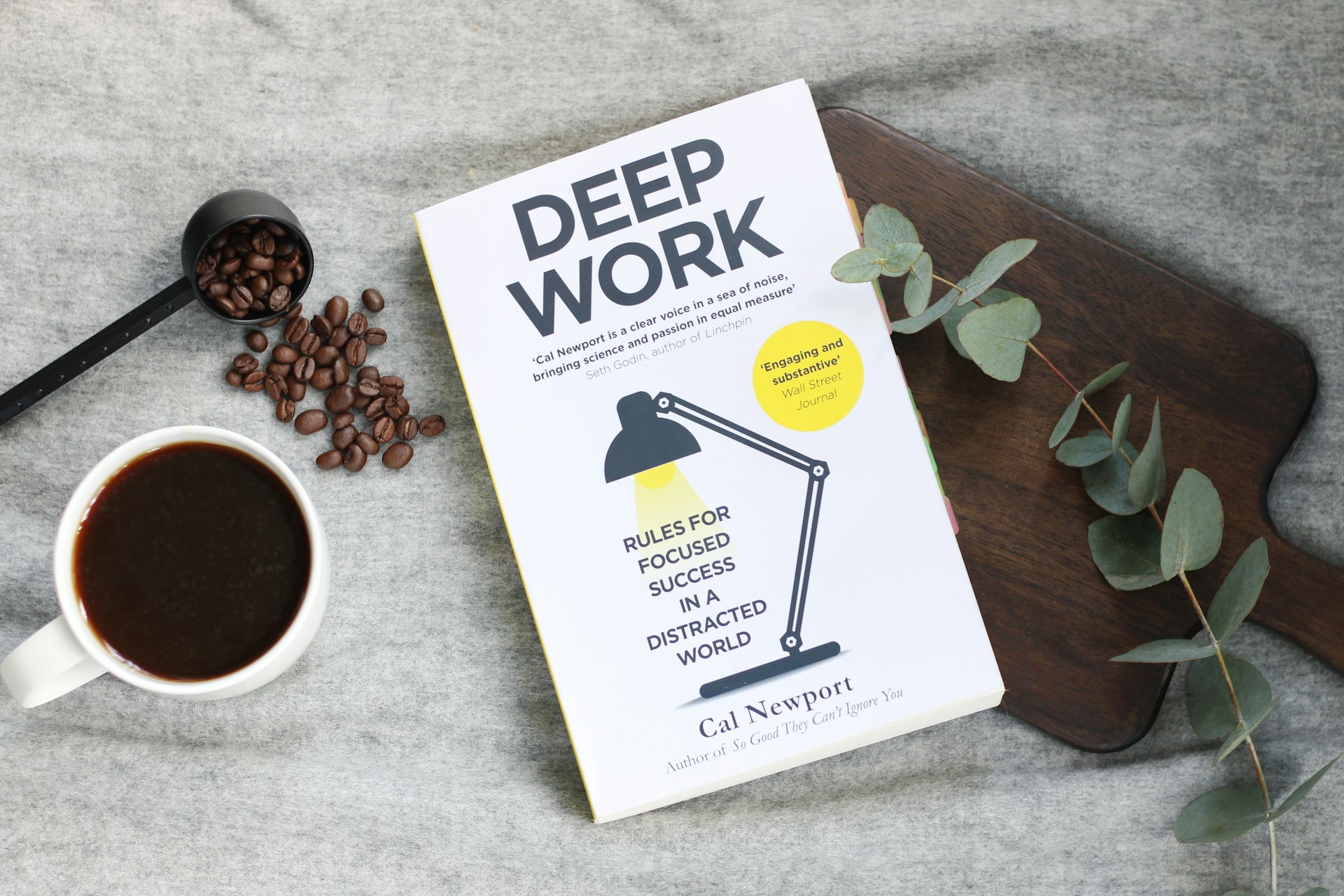
| Photo by Elin Melaas on Unsplash |
I was wrong.
A few ideas stuck with me more than I expected, and one of them changed how I think about my own system.
The distinction that matters
Newport splits work into two categories.
- Deep Work is anything done in a state of distraction-free concentration, pushing your cognitive abilities to the limit.
- Shallow Work is the rest: logistical, low-value, easy to do while half-distracted, and mostly forgettable a week later.
Nothing revolutionary so far. But then Newport makes a claim that’s easy to agree with in theory and hard to accept in practice: shallow work doesn’t just fail to move you forward. It actively erodes your ability to do deep work at all.
That one landed. In a job with 30-40 meetings a week and a Teams window that never stops blinking, I don’t lack the intention to do focused work. I actually lack the environment for it.
Why deep work is rare, even when everyone wants it
Two ideas explain why organizations (and individuals) drift toward shallow work almost by default.
The first is the Principle of Least Resistance: without clear feedback on what’s actually productive, people gravitate toward whatever is easiest in the moment. Answering an email is easier than writing a strategy. So email wins, over and over, until it fills the day.
The second is Busyness as Proxy for Productivity: since real output is hard to measure, visible busyness becomes the thing that is “measured”. You look productive answering messages in real time. You don’t look productive staring at a wall thinking. Even if the second one is where the actual value gets created.
I recognized both of these immediately, and not just in other people.
Rituals beat willpower
The part of the book I’ve actually started applying: willpower is a limited resource. You can’t just decide to concentrate harder every day and expect it to hold. What works instead is building rituals that make depth the default, not a daily act of self-discipline.
Newport describes two broad approaches: going bimodal (blocking off large, clearly separated stretches for deep work) or going rhythmic (short, focused sessions as a fixed daily habit). I lean rhythmic. Bimodal sounds great on paper, but between meetings I don’t control and a team that needs me reachable, large uninterrupted blocks are the exception, not the rule. And that might be the default at most leadership/management roles in larger corporations.
The idea I liked most, though, was the shutdown ritual: a fixed end-of-day routine where every open task and loose thread gets captured into a system you trust, so your brain is actually allowed to let go in the evening. This is close to what my own weekly review already does, just compressed to a daily version. I’m going to try adding one.
Training attention, not just protecting it
Newport treats concentration as a trainable skill, not a fixed trait (which I appreciated). Chronic multitasking measurably worsens your ability to filter out what’s irrelevant. That’s a cost most of us are paying without noticing.
Two concrete techniques stood out:
- Roosevelt Dashes: giving yourself an artificially tight deadline to force full concentration, similar to interval training for attention.
- Productive Meditation: actively thinking through a problem during an activity that doesn’t require cognitive focus, like walking.
I already do a version of the second one without realizing it had a name. Some of my clearest thinking on work problems happens on runs, not at my desk.
The Craftsman Approach to tools
As someone who spends a good part of his job evaluating and rolling out tools, this one stuck with me: adopt a tool only if its positive impact on what actually matters clearly outweighs the negative. Not “does everyone use it”, not “is it new”, not “could it theoretically help”. Does it clearly help the things that matter, more than it costs?
It’s a good filter.
I don’t think I apply it as consistently as I’d like to, professionally or personally. But I’ll try to use this kind of evaluation as much as I can.
What I actually took away
The idea that stuck with me most wasn’t from the Deep Work chapters at all. It was a side thought while reading: the difference between What and How.
Identifying the right strategy, the “what,” is usually the easier part. Most people can name a good goal or a sensible approach. Where it actually falls apart, for individuals and for entire companies, is the “how”: the execution. That’s a separate skill, and it’s the one that’s chronically underrated.
One framework that addresses this directly is 4DX (The 4 Disciplines of Execution): focus on the wildly important, act on lead measures, keep a compelling scoreboard and create a accountability-cadence (a weekly review, essentially). I’d read about 4DX before, but reading it right after Deep Work made the connection click: Deep Work tells you what to protect. 4DX tells you how to actually make sure you do it, week after week, not just on the days you feel disciplined.
That combination, not either book alone, is what I’m carrying forward.
If you’ve read Deep Work: which of Newport’s ideas actually changed something in how you work?