
I added Registers to LENS
I recently added another piece to LENS: Registers.
Meta, Projects, Logs and Knowledge Elements gave me a solid foundation, and it has worked well for months. Then I had a few calls with potential suppliers. I took notes and captured information that will become very useful later, for example when an issue hits and I need an external partner to resolve it.
 |
|---|
| Photo by Sufyan on Unsplash |
For a long time I kept a simple list of this in my favourite note-taking tool from back in the day: OneNote. Now it was time to move it to Obsidian as well.
But how?
The existing types didn’t fit. The information is almost as static as Projects, but there is no supplier list for it to link back to. It’s plain knowledge, yet it’s not a Knowledge Element, because it isn’t atomic. The true value of these documents emerges from their composition.
So is it Meta then?
Not really. Information gets added, but very seldom updated. These pages aren’t curated the way Meta pages are.
I discussed this with my note-curating agent, and we (it really was a joint effort) came up with a new type: Registers.
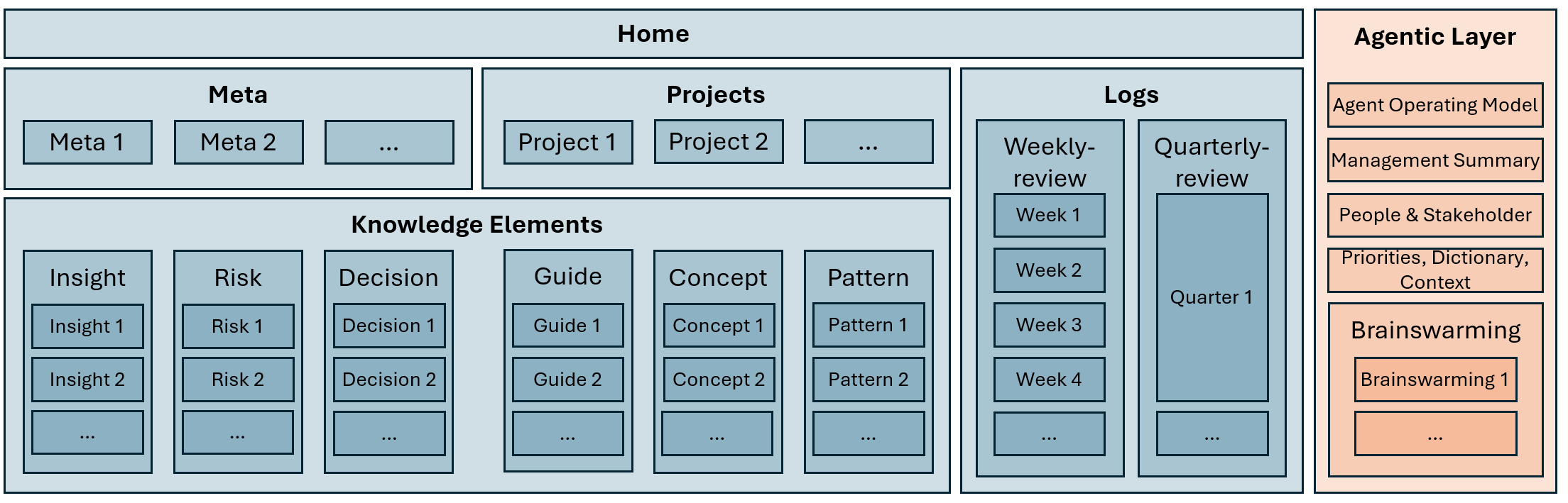 |
|---|
| LENS document hierarchy including Registers. Visualization by the author. |
A Register holds list-like structured knowledge, such as suppliers or stakeholders. It can also hold customers, which turns it into a mini CRM.
What it looks like
My supplier Register has three columns: company, category, and one fat column for everything else (notes, contacts, links).
| Company | Category | Notes, contacts, links |
|---|---|---|
| Example MES GmbH | MES | Strong on discrete manufacturing, weak on reporting. Contact: Anna Beispiel (sales), Max Muster (technical lead). Call 2026-09: open to a pilot on one line. See [[MES Interface Limits]] |
| Example Analytics | AI | Small team, fast delivery, no 24/7 support. Contact: Jane Doe. Referred by a peer in the industry. See [[Predictive Maintenance Data Requirements]] |
| Example Engineering AG | R&D | Good for one-off prototypes, expensive for anything recurring. Contact: John Roe. Link: company website, reference project PDF |
(All names are made up, obviously.)
The structure is deliberately dumb. No scoring, no status fields, no database ambitions. One row per company, and the notes column is where the real value sits. It’s the first place I look when I need someone external fast.
Links still work
When I talk to a business partner (supplier or customer) and a Knowledge Element emerges from my notes, I link to it from the Register. So the Register becomes the structured overview of the atomic notes that come out of contacts with business partners.
New to LENS? Start with the LENS hub.