
Why Owning a 3D Printer Changes How You See the World
Ever since 3D printing moved beyond laboratory settings, the technology fascinated me. But back in the early 2010s, home printers were either too fragile and required endless tinkering, or they were simply too expensive.
So, for years, I didn’t pay much attention to the field.
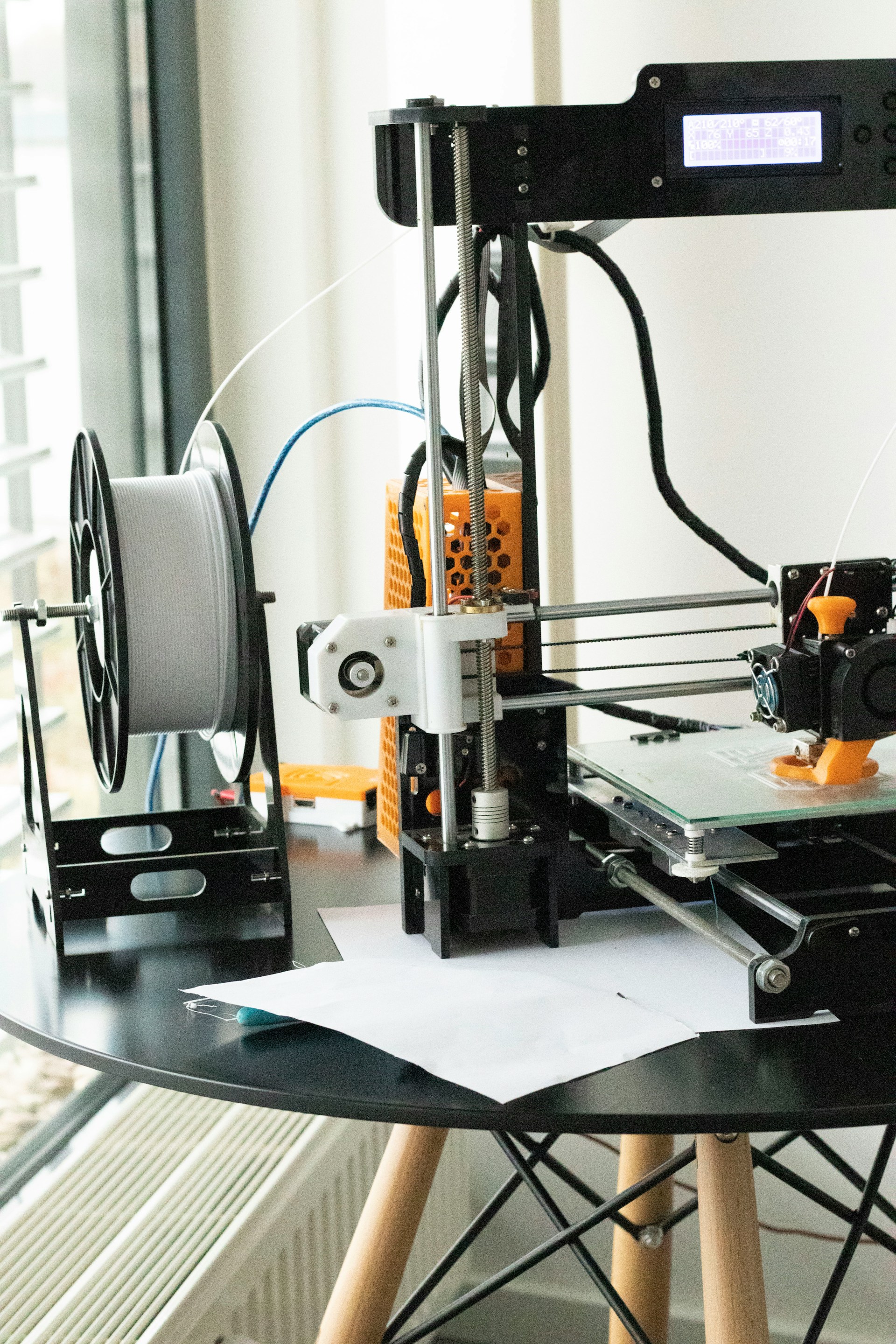 |
|---|
| Photo by New Data Services on Unsplash |
Then, recently, I stumbled upon a product on Instagram that caught my eye: a clever clamp for connecting cardboard into houses and forts for kids (called crockid). For the first time, I thought: How cool would it be to create something like this at home with a 3D printer?
That thought sent me down the rabbit hole. A quick search revealed just how far 3D printing has come. Today’s printers are almost plug-and-play, and the availability of ready-made models is staggering.
With end-of-year sales tempting me, I ordered a Bambu Lab A1 - a beginner-friendly printer with multi-color capabilities.
I’ve had it set up for a month now, and here’s what I’ve learned so far.
1. Don’t overthink the first prints
The sooner you start, the faster you’ll learn about design quirks and what to watch out for (at your models and at your printer).
Start simple: download ready-to-print models from sites like Makerworld (great for Bambu Lab printers), Printables, or Thingiverse.
Do you need ideas?
- Organization: Drawer dividers, cable clips, IKEA Skadis accessories
- Printer tools: Scrapers, dry-boxes, holders, calibration cubes
- Fun stuff: Toys for kids or for yourself (fidget spinners, puzzles)
Your first few print don’t have to be perfect. It’s about learning and having fun. Every layer teaches you something new.
2. You start seeing the world differently
I’ve read about this before, and now I can confirm - it’s true. Owning a 3D printer changes how you see the world. Suddenly, that wobbly shelf or awkward cable holder isn’t a nuisance. It’s a design challenge. You start thinking: I could fix that with a custom bracket or a clever clip.
You approach it with a maker-mindset: I could actually solve that problem by designing an X or simply downloading a Y.
In many cases 3D printing truly can save you from these small problems. But here’s the flip side: once you realize you can print almost anything, it’s tempting to overengineer solutions for problems that don’t really need fixing.
Next, let’s talk about where your printer lives and why that matters.
3. Location for your printer
One reason I waited to buy a 3D printer was simple: I didn’t have the right space for it. I didn’t want it in a living area, and I just didn’t have the room.
3D printers aren’t huge, but they need breathing room: at least half a desk plus space for tools and filament. When we moved this year, space was no longer an issue. I set mine up in a heated utility room with medium humidity, and so far, no problems.
Why does this matter? Humidity and temperature can make or break your prints. High humidity can damage filament and cause failures, so choose your spot wisely. In my case I custom-built a dry-box based on Ikea plastic boxes for my filament to live in.
4. The right material for the right application
Choosing the right filament is as important as the design itself. Each material has its strengths and weaknesses. Here’s a quick guide:
PLA: the beginner’s choice
- Pros: Easy to print, affordable, minimal warping
- Best for: Prototypes, decorative items low-stress parts. This is the best material for getting started.
- Cons: Brittle, not heat-resistant
PETG: the all-rounder
- Pros: Strong, flexible, good chemical resistance
- Best for: Functional parts, outdoor use, mechanical components
- Cons: Slightly harder to print than PLA, can string
TPU: the flexible one
- Pros: Elastic, impact-resistant
- Best for: Phone cases, gaskets, shock absorbers
- Cons: Requires slower print speeds and tuning
Specialty filaments (ABS, Nylon, Carbon-Fiber blends)
- Pros: High strength, heat resistance
- Best for: Industrial parts, high-performance applications
- Cons: More challenging to print, often needs an enclosure
5. 3D design is great
For many beginners, 3D modeling feels like a huge barrier. CAD software looks intimidating, and the learning curve seems steep.
With all the available portals offering ready‑made models, you often don’t actually need to create 3D designs yourself. You can download a solution for almost any problem. Still, don’t let 3D design intimidate you. Try building some models on your own.
Tools like Tinkercad make it easy to start. It’s browser-based, beginner-friendly and you can create your first design in minutes.
Personally, CAD wasn’t intimidating for me. As a mechanical engineering graduate, I’ve spent plenty of time with 3D modeling. But after moving into IT and digitalization early in my career, I rarely used those skills. Now, 3D printing feels like reconnecting with that part of my expertise.
Whether you’re a complete beginner or brushing up on old skills, learning 3D design really opens up endless possibilities in combination with a 3D printer.
6. Resist the urge to print every cool design you find online
If you have a hammer, everything looks like a nail. And if you own a 3D printer, suddenly every problem looks printable.
Even though a 3D printer is far more versatile than a hammer, it’s not the answer to everything. Often, magnets, wood boards, screws, or bearings are cheaper, stronger and more reliable.
The real magic happens when you combine 3D-printed parts with other materials. That’s when your creations go from good to next-level.
We’ve all seen prints that serve no purpose - neither functional nor decorative. They’re just wasted material and energy. Try to avoid falling into that trap.
Yes, I’ve printed a few fidget toys for fun as well. They’re a great way to show friends what a 3D printer can do. But I try not to print every cool fidget design I come across and instead focus on more practical parts. What helps is keeping a printing backlog: I’ve got over 99 designs queued up, and I prioritize mainly based on practical utility.
7. Make. Create. Share.
Owning a 3D printer isn’t just having a new cool tool a tech-savvy person needs to have at home. It unlocks new possibilities.
For me, it started with curiosity and a few simple prints in mind.
But it soon became more.
It changed how I see the world and how I approach problems.
And everything I learned, sparked new curiosity.
The real joy of 3D printing comes when you make something useful, create something unique, and then share it with others. Whether it’s a fun design, or a solution that saves someone time, sharing your work inspires others and strengthens the community of makers (and as I said in the beginning: it grew quickly the past few years).
So don’t wait for the perfect project. Start small, experiment, and share your journey. Every print is a step toward becoming more creative.
Thank you so much for reading! What’s the first thing you’d print if you had a 3D printer? Let’s discuss on LinkedIn
PS: I also found these cardboard connectors as a printable alternative.