
Why Mathematics Is the Operating System of Reality
In 1960, the physicist Eugene Wigner published an essay with a bold title: “The Unreasonable Effectiveness of Mathematics in the Natural Sciences”
Wigner pointed out something supernatural:
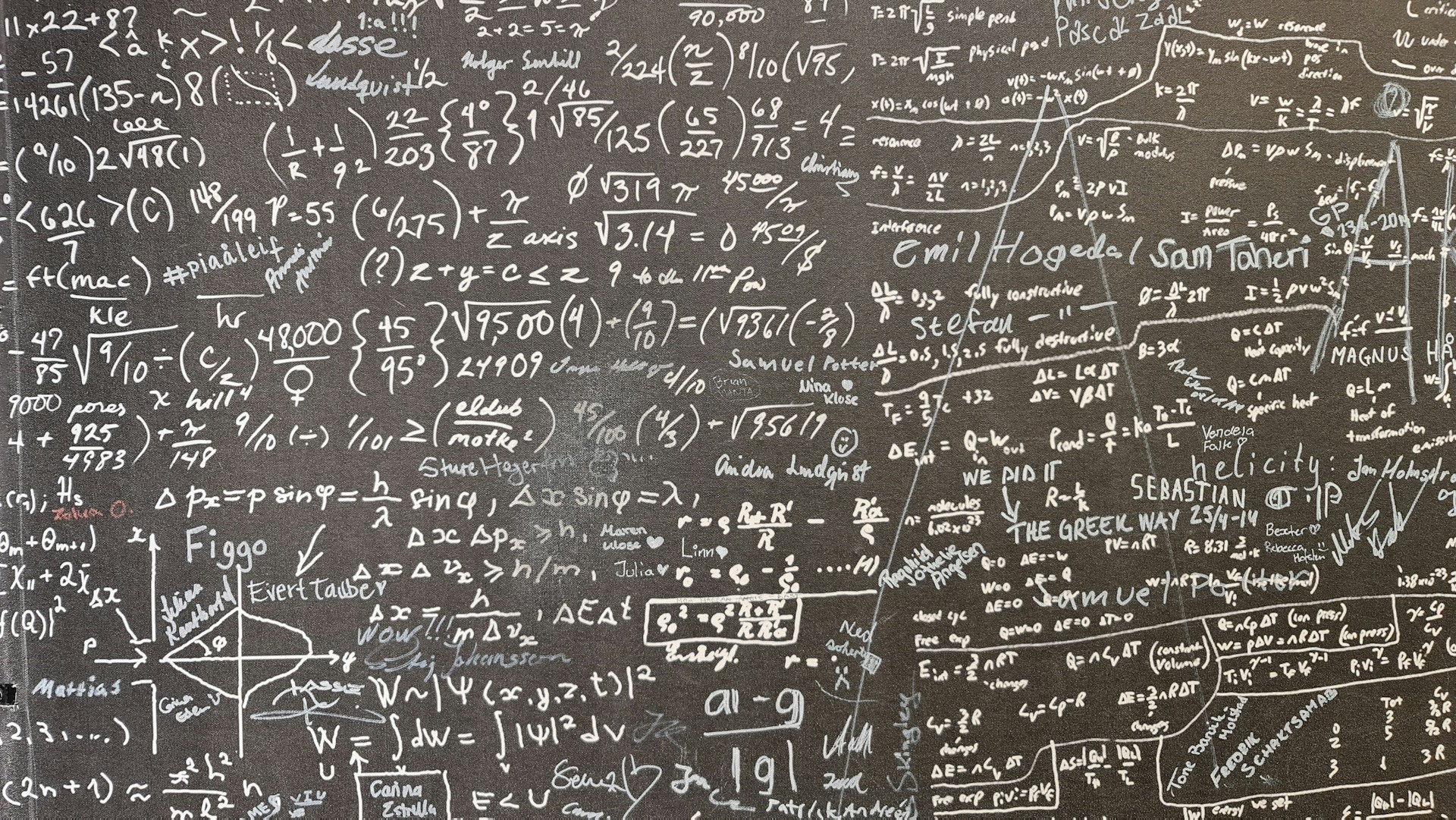
Mathematics (actually a creation of the human mind) somehow describes the physical world with unbelievable accuracy.
 |
|---|
| Photo by Thomas T on Unsplash |
Equations invented long before anyone knew atoms existed ended up predicting atomic behavior.
Abstract geometric ideas helped explain gravity.
Pure theoretical mathematics suddenly appeared in quantum mechanics, almost like the universe had been waiting for us to discover it.
Wigner admitted he had no explanation.
He simply called it a miracle.
And this miracle raises a fascinating question:
If math fits reality so perfectly, maybe it’s because math is built into reality. Maybe mathematics is the operating system running underneath everything.
I’ve always liked maths, but I’ve never seen it this way until I recently stumbled upon Wigner’s essay. However, once you look at life this way, everything changes: including how you lead, how you work, and how you design your days.
Let’s explore that idea.
1. Wigner’s insight: the universe speaks math
Wigner’s essay forces us to confront a strange truth:
Mathematics isn’t just a tool. It’s a language the universe already uses.
- Mathematical formulas, initially developed “just for fun” predicted real physical laws later on.
- Patterns found in theory ended up being patterns in nature.
- Even messy systems like gases or waves obey elegant equations.
This is not normal.
It shouldn’t happen.
And yet it does. Always.
So if the universe runs on math, then the moment you start viewing your own life as a system with rules, patterns and constraints, you start seeing it more clearly.
2. Math reveals structure where we only see chaos
Wigner said mathematics helps us “find the right abstractions”.
In other words: it reveals the hidden order. That same idea applies far beyond physics. Take your daily life for example:
- Too many tasks
- Competing priorities
- Sudden interruptions
- Emotional noise
- …
It looks chaotic, but underneath it, there is a structure. There are patterns just waiting to be discovered. Mathematical thinking asks:
- What repeats?
- What are the constraints?
- Where are the leverage points?
That actually is leadership.
And it starts with the same mindset Wigner admired: “search for the pattern, not the chaos”.
3. Math turns the complex into something simple
Wigner showed that math compresses reality. Huge, complex systems can be described by a small set of rules. That’s exactly what high-performance systems do:
- break projects into pieces
- simplify decisions
- reduce friction
- standardize routines
4. Math helps you see the future more clearly
Wigner wasn’t claiming math predicts everything, just that it predicts far more than we have any right to expect. In real life, we see the same phenomenon:
- Daily habits compound.
- Skills improve with deliberate practice.
- Poor communication creates predictable friction.
- Processes break where bottlenecks form.
These aren’t mysteries. They’re patterns.
When you understand these patterns, you don’t need perfect prediction.
You just need direction.
5. Math brings calm (because it brings clarity)
Wigner argued that mathematical laws make the world less mysterious.
They give us a stable foundation.
When you apply that thinking to your own life, it can be a key to become calmer:
- You stop fighting constraints and accept their existence.
- You stop expecting unrealistic results.
- You accept that systems behave based on underlying rules (even if they have yet to be discovered).
- You look for influence instead of control.
Seeing your life mathematically turns panic into understanding.
And good leaders understand systems don’t react emotionally. They act based on variables and so they adjust exactly the variables they have control over.
6. Math lets you design a better operating system for yourself
Wigner marveled at how mathematics describes reality.
But you can take it one step further for yourself:
You can use mathematics to design reality (at least the slice of reality you can actually control).
- Inputs: habits, energy, priorities
- Throughput: focus, workflows, constraints
- Output: results, growth, quality
- Feedback: reflection, analytics, learning
Once you design around these laws, your productivity becomes smoother.
Your leadership becomes clearer.
Your decisions become sharper.
You’re no longer guessing.
You’re operating on the same principles the universe uses.
7. Math ultimately is about truth
Wigner ended his essay with humility.
He admitted we don’t fully understand why math works so well. Only that it does.
And that’s the deeper lesson for life:
Mathematics is a search for honest structure. A search for clarity. A search for truth.
And when you apply that to your days to your goals, your systems, your leadership: life becomes less chaotic and more intentional.
Final thoughts
Wigner saw mathematics as a miracle.
He believed it shouldn’t work as well as it does and yet it does, reliably and beautifully.
Maybe the simplest explanation is this:
Mathematics is not outside the universe. It is the logic of the universe. It’s the operating system.
This article is based on the assumptions from Eugene Wigner’s Essay “[The Unreasonable Effectiveness of Mathematics in the Natural Sciences](https://webhomes.maths.ed.ac.uk/~v1ranick/papers/wigner.pdf)”